
What is the '10-Tab Workday' and Why Is It Dying?
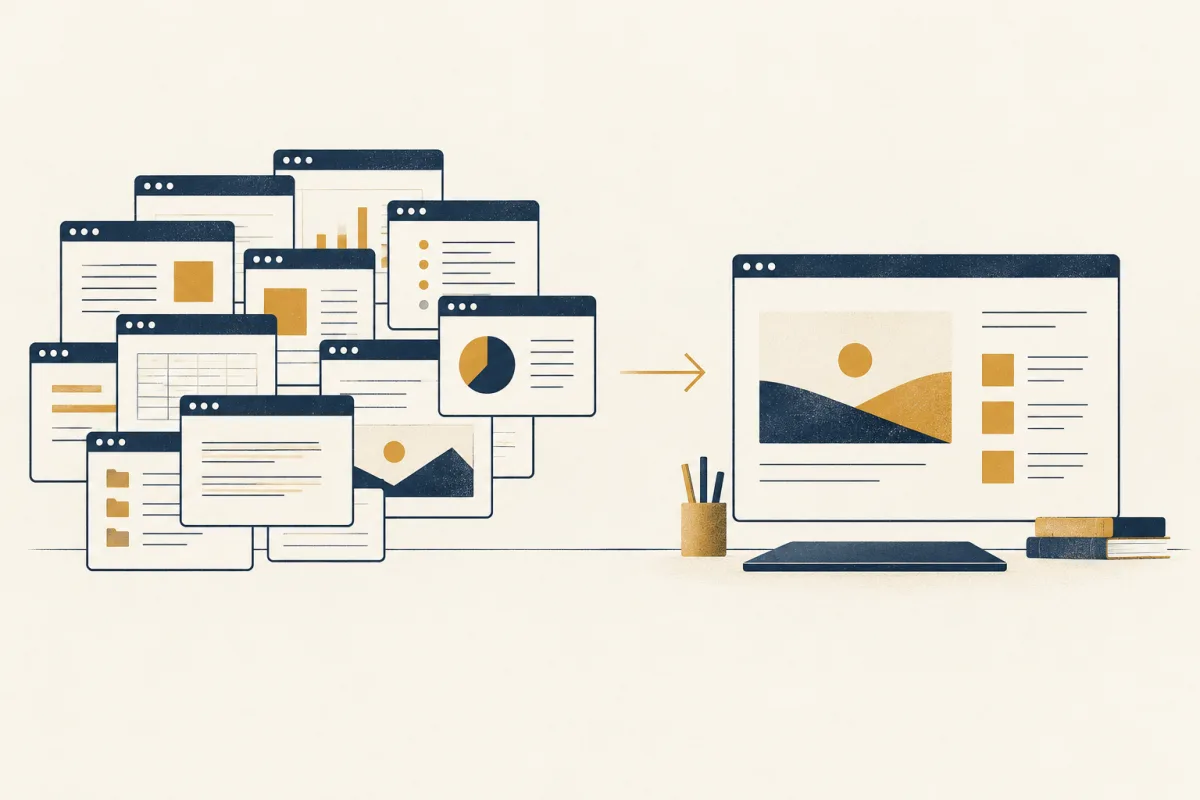
The '10-Tab Workday' is the all-too-common reality of modern business operations, where professionals juggle a dozen or more single-purpose applications just to get through the day. It's the chaotic digital desktop where your CRM, email marketing tool, scheduler, project manager, and invoicing software all live in separate, non-communicating browser tabs. This fragmented approach is dying because it's fundamentally inefficient, expensive, and unsustainable in an increasingly competitive landscape.
Switching between tools interrupts work and creates more places to check for updates. Track a few common tasks to see how much time your team spends searching, copying data and resolving conflicting records.
Beyond productivity, this fragmentation creates dangerous data silos. When customer information lives in one tab and project details in another, you never get a complete picture. This leads to missed opportunities, poor customer service, and flawed decision-making. The rising costs of multiple subscriptions—what many now call 'SaaS-flation'—only add financial strain to the operational chaos.
What Major Trends Are Driving This Shift?
Building on the breakdown of the old model, three powerful, interconnected trends are forcing a fundamental rethinking of the business software stack. These aren't just incremental improvements; they represent a seismic shift towards a more integrated, intelligent, and accessible future. The primary drivers are the maturation of consolidated platforms, the rise of AI as a core operational layer, and the democratization of automation through no-code tools.
The Rise of the Consolidated Platform
For years, the prevailing wisdom was 'best-of-breed'—picking the top-rated tool for every individual task. The result? A complex, expensive, and poorly integrated web of software. The new paradigm is the consolidated, all-in-one platform. Businesses are realizing that the seamless integration of an all-in-one solution provides far more value than the marginal benefits of a dozen niche tools.
These platforms centralize data, providing a single source of truth for every customer interaction, project, and financial transaction. This not only eliminates data silos but also drastically simplifies IT management and reduces security risks. The ultimate goal is to streamline your business with a unified solution that connects every department.
AI as the New Operating System
AI may become a larger part of everyday business software. The useful question is which tasks it can support reliably, with clear permissions and human review.
Imagine an AI assistant that drafts follow-up emails based on call transcripts, schedules meetings automatically by analyzing your pipeline's urgency, and flags at-risk customers before they even think of churning. These aren't futuristic fantasies; these are the capabilities being embedded into forward-thinking platforms today. This is about transforming operations with powerful AI business tools that work for you, not the other way around.
The Democratization of Automation
In the past, automating a business process required developers and complex code. Today, the rise of no-code and low-code platforms empowers anyone to become a builder. This 'democratization' means that the people who actually understand the business challenges—the sales managers, marketing coordinators, and operations leads—can now design and implement their own automated workflows without writing a single line of code.
This shift is monumental. It accelerates innovation, reduces reliance on over-burdened IT departments, and allows for hyper-specific automations that perfectly match a team's unique needs. By 2027, visual drag-and-drop workflow builders will be as standard in business software as email is today.
How Will Daily Operations Change for Businesses by 2027?
By 2027, the daily workflow for a typical manager or entrepreneur will be unrecognizable from today's chaotic, multi-tab environment. Operations will be managed from a single, intelligent 'command center' that provides a holistic view of the entire business. This unified workspace will be proactive, predictive, and personalized, serving up the right information at the right time and automating the administrative burden that currently consumes so much of our day.
Instead of manually checking five different systems to prepare for a client call, you'll have a single dashboard that automatically compiles the client's entire history: recent support tickets, outstanding invoices, marketing engagement, and active project statuses. Your AI assistant will have already summarized the key talking points and suggested next steps.
This table illustrates the stark difference between the current state and the near future:
| Operational Aspect | The 10-Tab Workday (Today) | The Unified Workspace (2027) |
|---|---|---|
| Data Management | Fragmented across multiple apps, leading to data silos and manual entry. | Centralized in a single platform, providing a 360-degree customer view automatically. |
| Workflow Automation | Limited and requires complex third-party tools like Zapier to connect systems. | Native, no-code automation built into the platform, managed with visual builders. |
| Decision Making | Reactive, based on manually compiled reports from different sources. | Proactive and predictive, with AI-driven insights and forecasting surfaced in real-time. |
| User Experience | High friction due to constant context switching and inconsistent interfaces. | Seamless and intuitive, with a single, personalized interface for all tasks. |
What Challenges Will Businesses Face During This Transition?
While the future of a unified, intelligent workspace is promising, the journey there won't be without its hurdles. The primary challenges businesses will face are not technological but human and procedural. Successfully navigating this transition will require careful planning around data migration, fostering employee adoption, and selecting a platform that offers both depth and flexibility.
Overcoming Data Fragmentation
The first major obstacle is untangling the web of data scattered across your existing tools. Migrating years of customer data, financial records, and project files from a dozen different systems into one new platform can be a monumental task. It requires a clear strategy for data cleaning, mapping, and validation to ensure nothing critical is lost in translation.
Managing Employee Adoption
Change is hard. Your team is accustomed to their current tools, even with all their flaws. Introducing a new, all-encompassing platform requires a thoughtful change management process. This involves clear communication about the benefits, comprehensive training, and creating internal champions who can guide their peers. Without buy-in from the team, even the best software will fail.
Avoiding 'Walled Garden' Syndrome
While all-in-one platforms are powerful, no single solution can do everything perfectly for every business. The challenge is to choose a platform that is comprehensive enough to replace the majority of your tools but also open enough to integrate with any mission-critical legacy systems or specialized software you need to keep. A truly future-proof platform must be a powerful core, not a locked cage.
What's the Bottom Line for Your Business?
The prediction is clear: the fragmented, inefficient 10-tab workday is on its last legs. The convergence of platform consolidation, embedded AI, and accessible automation is creating a new standard for business management. Resisting this change isn't a viable long-term strategy. The businesses that thrive in the coming years will be those that embrace this shift toward a single, intelligent, and unified operational hub.
- Consolidation is Inevitable: The cost and complexity of managing dozens of tools are pushing businesses toward all-in-one platforms.
- AI is the New Engine: Artificial intelligence will move from a 'feature' to the fundamental operating system that drives proactive and predictive work.
- Automation is for Everyone: No-code tools will empower non-technical staff to build the solutions they need, accelerating efficiency and innovation.
- The Focus is Shifting: The goal is no longer just about completing tasks, but about eliminating friction and creating a seamless flow of information across the entire business.
The move towards a unified business platform is more than a trend—it's a strategic imperative for growth and efficiency. To better understand if your current tool stack is holding you back, exploring the common signs that you need a new CRM can be a revealing next step.
Frequently Asked Questions
What if I prefer using the 'best' tool for each specific job?
A shared platform can reduce the number of connections your team maintains, but specialist tools may still be necessary. Compare your required workflows directly; no fixed percentage describes how well one platform replaces another.
Will AI really replace jobs in business operations?
The goal of AI in business management isn't replacement, but augmentation. AI is exceptionally good at handling repetitive, data-intensive tasks like data entry, scheduling, and report generation. This frees up human team members to focus on high-value activities that require creativity, strategic thinking, and complex problem-solving.
How can a small business afford this kind of advanced technology?
This is where the market has changed dramatically. Previously, this level of integration and AI was reserved for large enterprises with huge budgets. Today, platforms like ThriveBase are specifically designed to deliver enterprise-grade power at small business-friendly pricing, making it accessible for companies of any size to compete and grow.