
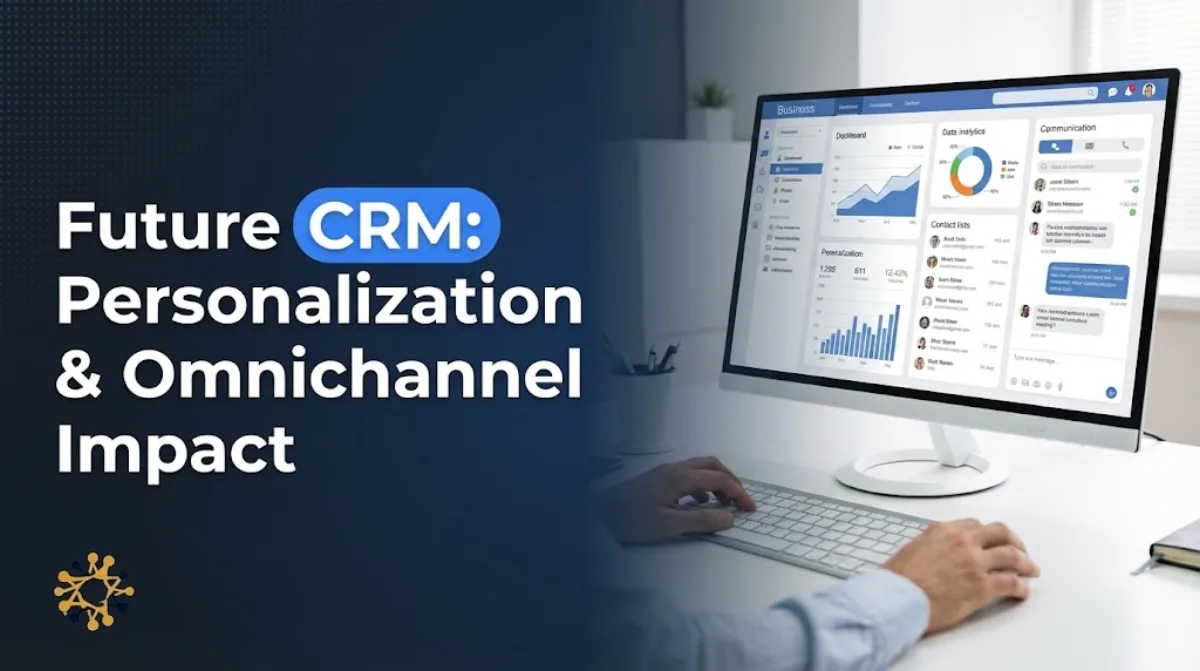
Imagine a CRM system that doesn't just store data, but anticipates every customer's need, predicts their next move, and delivers a perfectly tailored interaction across every single touchpoint. Sounds like science fiction? Not for long. By 2026, the traditional CRM will be unrecognizable, transformed by an insatiable demand for hyper-personalization and truly seamless omnichannel experiences.
We're moving beyond mere customer data management into an era where CRM becomes the intelligent nervous system of an entire business, orchestrating customer relationships with unprecedented precision and foresight. For business leaders, understanding this evolution isn't just about staying competitive; it's about redefining what customer engagement truly means.
What's Driving the Shift Towards Hyper-Personalized CRM?
The primary driver behind the push for hyper-personalized CRM is the evolving customer expectation for relevant, timely, and context-aware interactions. Customers no longer tolerate generic messages or disjointed experiences; they expect brands to understand their individual preferences, purchase history, and even their emotional state at any given moment.
This shift is fueled by the explosion of data, advancements in AI and machine learning, and the increasing sophistication of predictive analytics. Businesses that can harness these elements to deliver unique customer journeys will not only thrive but set new industry benchmarks.
Key Takeaway: The future of CRM isn't just about data; it's about using intelligence to deliver deeply personal, proactive customer experiences that build lasting loyalty.
How Will Omnichannel Experiences Redefine Customer Journeys?
Omnichannel experiences will redefine customer journeys by ensuring absolute consistency and fluidity across all communication channels, making every interaction feel like a continuation of a single, intelligent conversation. This means a customer can start a chat on your website, receive an email follow-up, and then have a sales call where the agent already knows the entire history of their previous interactions, without missing a beat.
A connected customer record can reduce the need for customers to repeat information. In ThriveBase, review the conversations available through your configured channels alongside contact and pipeline details. Verify which channels and historical records are included before relying on the record for a handover.
The Evolution of Customer Touchpoints
AI-Powered Chatbots: Moving beyond simple FAQs to intelligent conversational agents that can resolve complex issues and guide customers proactively.
Predictive Outreach: CRM systems will identify potential issues or opportunities and initiate contact with customers before they even realize a need.
Seamless Device Handoff: Starting a conversation on mobile and effortlessly continuing it on a desktop, with all context preserved.
Personalized Content Delivery: Dynamically adjusting website content, email offers, and even in-app messages based on real-time customer behavior and preferences.
What Role Will AI and Automation Play in Future CRM?
AI and automation will serve as the indispensable backbone of future CRM, enabling hyper-personalization and omnichannel consistency by automating repetitive tasks, providing predictive insights, and empowering human agents with real-time intelligence. We're talking about AI-powered lead scoring, automated workflow triggers, and intelligent routing of customer inquiries that significantly boost efficiency and reduce response times.
AI-assisted transcripts and drafts can help a team review conversations and prepare a response. Check the available features for your calling setup, and have a person verify names, commitments and next actions before acting on generated text.
Automation's Impact on the Sales Funnel
Consider the evolution of sales automation. In the past, it was about automating email blasts. Today, and certainly by 2026, it's about:
Aspect | Traditional CRM Automation | Future CRM Automation (2026) |
|---|---|---|
Lead Scoring | Manual or rule-based, often inaccurate. | AI-driven predictive scoring based on behavioral patterns and external data. |
Customer Interaction | Reactive, agent-initiated responses. | Proactive, AI-suggested next best actions, automated personalized outreach. |
Workflow Management | Basic task automation, often requiring setup. | Intelligent, self-optimizing workflows adapting to real-time data and user behavior. |
Data Insights | Retrospective reports, manual analysis. | Real-time, predictive analytics with actionable recommendations for sales and marketing. |
This level of automation means businesses can scale their personalization efforts without scaling their headcount proportionally. It's about working smarter, not harder, and achieving growth that might otherwise be out of reach.
How Can Businesses Prepare for This CRM Evolution?
Businesses can prepare for this CRM evolution by investing in integrated, flexible platforms that prioritize automation, AI capabilities, and a unified customer view, while also fostering a culture of data-driven decision-making. The days of disparate tools creating data silos are quickly fading; an all-in-one approach is becoming essential.
Start by evaluating your current CRM setup. Does it offer robust AI assistance, comprehensive workflow automation, and the ability to seamlessly manage communications across email, SMS, and calls? If not, it might be one of the 10 signs you need a new CRM. Platforms designed for the future, like ThriveBase, offer enterprise-grade features at small business-friendly pricing, enabling SMEs to compete effectively by streamlining operations and enhancing customer engagement.
Key Preparation Strategies
Consolidate Your Tech Stack: Move away from fragmented tools towards a single, integrated business management platform. This is a core tenet of streamlining operations with all-in-one solutions.
Prioritize Data Quality: Clean, accurate data is the foundation for effective AI and personalization. Implement robust data governance policies.
Embrace AI & Automation: Look for solutions that embed AI for predictive analytics, task automation, and intelligent customer interactions.
Focus on Training: Ensure your teams are equipped to leverage new CRM capabilities, understanding how to interpret AI insights and manage automated workflows.
Cultivate a Customer-Centric Culture: Reinforce the importance of personalized, consistent customer experiences across all departments.
The transition won't happen overnight, but businesses that embrace these changes proactively will be well-positioned to leverage the full potential of future CRM, transforming customer relationships into a powerful engine for growth. The ability to deploy rapidly and without technical skills, as ThriveBase offers, is critical for busy business owners looking to adopt these advanced capabilities quickly.
What's the Bottom Line?
The future of CRM, by 2026, is fundamentally about delivering hyper-personalized, seamless omnichannel experiences, powered by advanced AI and automation. Businesses must move beyond traditional data management to proactive, intelligent relationship orchestration. This evolution demands:
Integrated Platforms: Replacing disconnected tools with all-in-one solutions that centralize customer data and interactions.
AI-Driven Personalization: Leveraging machine learning to anticipate customer needs and tailor every touchpoint.
Seamless Omnichannel Journeys: Ensuring consistent and fluid interactions across all communication channels.
Strategic Automation: Automating repetitive tasks to free up teams for higher-value customer engagement.
Adaptability: Choosing flexible, scalable solutions that can evolve with future technological advancements and customer expectations.
Embracing these shifts will be crucial for any business aiming to not just survive but thrive in the competitive global market.
Frequently Asked Questions
How quickly can businesses implement these advanced CRM features?
The time needed depends on data quality, permissions, channel setup and the workflow. Test a small sample first, then plan the wider rollout using what you learn.
Do I need extensive technical skills to manage an AI-powered omnichannel CRM?
Not at all. The trend in CRM development is towards user-friendliness and low-code/no-code interfaces. Platforms like ThriveBase are specifically built for busy business owners, offering intuitive dashboards and AI assistants that simplify complex tasks, making advanced CRM accessible without specialized technical skills.
How does an all-in-one platform support future CRM trends?
An all-in-one business management platform inherently supports future CRM trends by eliminating data silos and providing a unified view of the customer across all functions. This integration is crucial for delivering consistent omnichannel experiences and feeding comprehensive data to AI for accurate personalization, making it an ideal foundation for modern CRM.
What are the cost implications of adopting future-ready CRM solutions?
While enterprise-grade features might seem expensive, the market is shifting. Solutions like ThriveBase offer advanced AI and comprehensive integration at small business-friendly pricing. By replacing multiple disconnected tools with one platform, businesses often save money while gaining superior functionality and efficiency.