
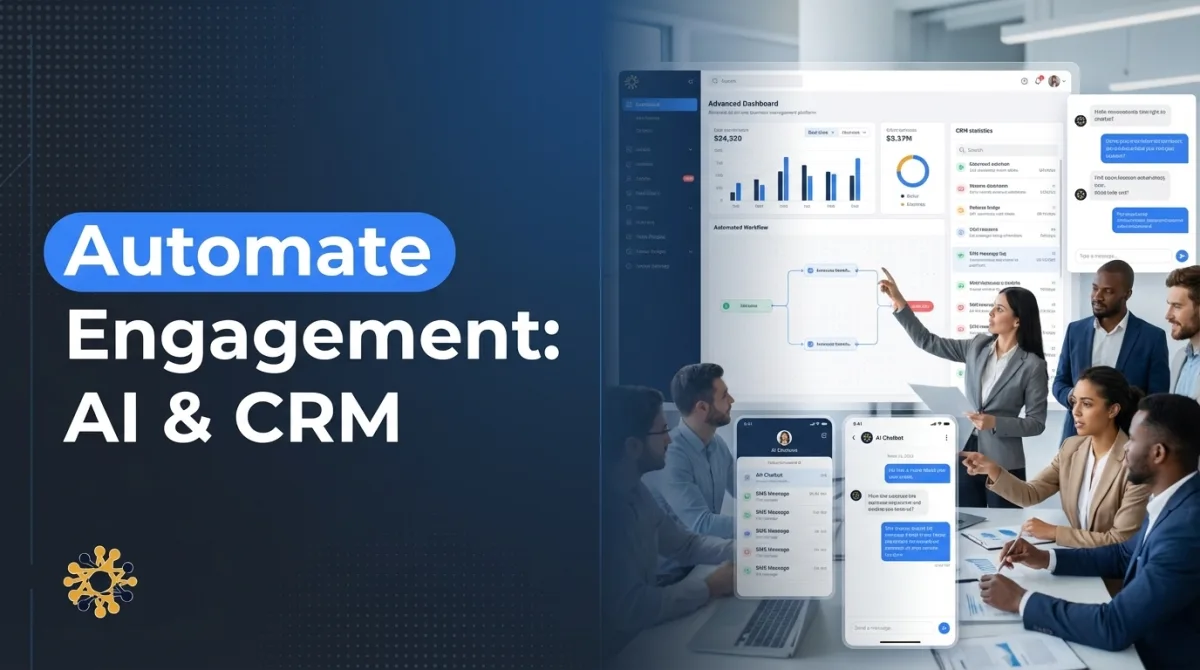
A customer follow-up process needs clear ownership, accurate records and appropriate timing. CRM, SMS and AI tools can support parts of that process, but automated messages still need consent, monitoring and a route to a person.
You're likely juggling various tools, facing data silos, and struggling to provide consistent, timely interactions across every touchpoint. What if you could eliminate those headaches and create a seamless, intelligent customer journey that nurtures leads, supports customers, and drives growth automatically?
Why is an Automated Customer Engagement System Essential for Modern Businesses?
An automated customer engagement system is essential because it allows businesses to deliver personalized, consistent, and timely interactions across all touchpoints without manual intervention, significantly boosting efficiency and customer satisfaction. This integration eliminates data silos, ensures no lead or customer query falls through the cracks, and frees up your team to focus on higher-value tasks, aligning perfectly with the growing demand for strategic automation.
Manual follow-up becomes harder to manage as the number of enquiries grows. Start by measuring missed follow-ups and time spent on repetitive work. Use those measures to assess whether an automated step improves the process.
Beyond cost savings, automation fosters a consistent brand experience. Every interaction, from the initial lead capture to post-purchase support, can be orchestrated to reflect your brand's voice and values. This level of consistency builds trust and loyalty, which are invaluable assets in any market.
What are the Core Components of an Integrated Engagement System?
The core components of an integrated customer engagement system are Customer Relationship Management (CRM) for data centralization, SMS for direct and immediate communication, and Artificial Intelligence (AI) for intelligent automation and personalization. Together, these elements create a powerful synergy that transforms how businesses interact with their audience.
Let's break down each element and understand its unique contribution to a unified system.
CRM: The Foundation for Data Centralization
Your CRM isn't just a contact list; it's the central nervous system of your customer engagement. It stores every interaction, preference, and historical data point, providing a 360-degree view of each customer. This comprehensive data is critical for personalization and effective segmentation.
Without a robust CRM, your engagement efforts become fragmented, leading to inconsistent messaging and missed opportunities. It's the single source of truth that powers all your automated campaigns.
SMS: Direct & Immediate Communication
SMS can be useful for time-sensitive messages when customers have agreed to receive them. Provide a clear opt-out and measure delivery and responses rather than assuming an open rate.
Used strategically, SMS can significantly enhance response times and customer satisfaction, especially when integrated with your CRM data to ensure messages are relevant and well-timed.
AI: The Intelligence Layer for Dynamic Interactions
AI brings predictive power and dynamic interaction capabilities to your engagement strategy. AI-powered chatbots can handle routine inquiries 24/7, providing instant support and qualifying leads. Machine learning algorithms can analyze customer behavior to predict needs and recommend personalized actions, elevating your workflow automation significantly.
As discussed in The Ultimate Guide to AI Business Tools, AI can also assist with content generation, sentiment analysis, and optimizing communication channels for maximum impact.
How Do You Design Your Automated Customer Engagement Workflow?
To design your automated customer engagement workflow, begin by mapping your customer journey, identifying key automation opportunities, defining clear triggers and actions, crafting personalized messages, and finally, incorporating AI for dynamic and intelligent interactions. This structured approach ensures a comprehensive and effective system.
Designing an effective automated system requires thoughtful planning. Here's how to approach it:
Step 1: Map Your Customer Journey
Start by visualizing every stage a customer goes through, from awareness to advocacy. What are their pain points? What information do they need? Where do they interact with your business? This mapping reveals critical touchpoints for automation.
Step 2: Identify Automation Opportunities
Pinpoint repetitive tasks, common customer inquiries, and critical follow-up sequences that can be automated. Think about lead nurturing, onboarding, support tickets, and re-engagement campaigns. For example, automatically sending a welcome SMS after a new sign-up.
Step 3: Define Triggers and Actions
A trigger is an event that initiates an automated sequence (e.g., a form submission, a purchase, a website visit). An action is the automated response (e.g., send an email, create a task, update a CRM field, send an SMS). Clearly define these for each step of your workflow.
Step 4: Craft Personalized Messages
Leverage your CRM data to personalize every message. Use customer names, past purchase history, and specific interests to make communications relevant. Generic messages are easily ignored; personalized ones drive engagement and conversions.
Step 5: Incorporate AI for Dynamic Interactions
Integrate AI to make your workflows smarter. An AI chatbot can answer FAQs before escalating to a human, or an AI assistant can suggest the next best action for a sales rep based on customer behavior. This adds a layer of intelligence that static automation can't provide.
Aspect | Manual Engagement | Automated Engagement |
|---|---|---|
Response Time | Variable, often delayed | Instant (24/7) |
Personalization | Limited, prone to error | High, data-driven |
Consistency | Inconsistent across channels | Uniform and reliable |
Scalability | Difficult, requires more staff | Seamlessly scales with growth |
Cost Efficiency | Higher labor costs | Reduced operational expenses |
What are the Practical Steps to Implement Your Automated System?
To implement your automated system, you'll need to choose an integrated platform, configure your CRM, set up SMS integration, deploy AI chatbots, build your automated sequences, and rigorously test and refine each component. This systematic approach ensures a smooth transition and effective operation.
Once your workflow is designed, it's time to bring it to life.
Choose the Right Platform
The cornerstone of a truly automated system is a platform that consolidates CRM, SMS, and AI capabilities. Avoid the trap of stitching together disparate tools, which often leads to integration headaches and data silos. Solutions like ThriveBase, for example, offer an all-in-one approach, replacing multiple individual tools with a single, integrated platform. This simplifies your tech stack and ensures seamless data flow.
For more on this, consider The Ultimate Guide to Streamlining Your Business with All-in-One Solutions.
Configure Your CRM
Input all your existing contact data, segment your audience based on demographics, behavior, and preferences, and customize fields to capture relevant information for your automated workflows. A well-organized CRM is crucial for personalized communication.
Set Up SMS Integration
Connect your SMS gateway within your chosen platform. Define templates for common messages (e.g., appointment confirmations, order updates, promotional offers) and ensure they are linked to specific triggers in your CRM.
Deploy AI Chatbots
Integrate AI chatbots into your website, social media, and messaging apps. Train them with FAQs, define escalation paths for complex queries, and ensure they can pull relevant customer data from your CRM to provide personalized responses. This is where AI truly shines in enhancing customer experience.
Build Your Automated Sequences
Using your platform's workflow automation builder, create your multi-channel sequences. For instance, a new lead might receive an email, then an SMS reminder after two days if they haven't responded, followed by an AI chatbot prompt on the website. This orchestrated approach ensures consistent engagement.
Test and Refine
Test each sequence with sample contacts before enabling it for customers. Check consent, timing, stop conditions, duplicate messages and handover to a person. Review results and adjust the workflow when something fails.
How Can You Optimize and Scale Your Automated Engagement?
To optimize and scale your automated engagement, continuously monitor performance metrics, conduct A/B testing on your campaigns, leverage data for predictive insights, and expand your automation capabilities as your business grows. This iterative process ensures your system remains effective and efficient.
Building your system is just the beginning. Continuous optimization is key to long-term success.
Monitor Performance Metrics
Regularly track key performance indicators (KPIs) such as open rates, click-through rates, conversion rates, customer satisfaction scores, and response times. Your platform's customizable dashboards should provide these insights at a glance, allowing you to identify what's working and what needs adjustment.
A/B Test Your Campaigns
Experiment with different subject lines, message content, call-to-actions, and even timing for your automated sequences. A/B testing helps you understand what resonates best with your audience, enabling data-driven improvements to your workflow automation.
Leverage Data for Predictive Insights
As your system collects more data, use AI and analytics features to identify trends and predict customer behavior. For example, you might predict which customers are at risk of churn and trigger a proactive re-engagement campaign. This moves you from reactive to proactive customer management.
Expand Your Automation Capabilities
As your business evolves, look for opportunities to automate more processes. This could involve integrating with other business tools, expanding into new communication channels, or implementing more complex AI-driven workflows. Platforms that offer no-code or low-code options, like those mentioned in How to Streamline Your Business with No-Code Platforms, make this expansion much easier.
Key Takeaway: A truly integrated customer engagement system isn't a one-time setup; it's an evolving ecosystem that requires continuous monitoring, testing, and adaptation to maximize its impact on customer satisfaction and business growth.
Building a fully automated customer engagement system with CRM, SMS, and AI in one platform is a strategic move that can dramatically transform your business operations and customer relationships. By adopting an integrated approach, you can eliminate inefficiencies, provide unparalleled personalization, and scale your engagement efforts without increasing your workload. If you're looking to consolidate your tools, streamline your processes, and empower your team to focus on growth, exploring an all-in-one business management platform is a logical next step.
What's the Bottom Line?
Unified Platforms are Key: Integrating CRM, SMS, and AI within a single platform is crucial for seamless data flow and consistent customer engagement.
Strategic Workflow Automation: Design your workflows by mapping the customer journey, identifying triggers, and crafting personalized, multi-channel messages.
AI Drives Intelligence: AI chatbots and predictive analytics enhance personalization and provide 24/7 support, making your system dynamic and responsive.
Continuous Optimization: Regularly monitor KPIs, A/B test campaigns, and leverage data to refine and scale your automated engagement efforts for sustained success.
Efficiency and Growth: An automated system saves time and money, improves customer satisfaction, and frees your team to focus on strategic, high-value activities.
Frequently Asked Questions
What are the primary benefits of an all-in-one platform for customer engagement?
An all-in-one platform centralizes all customer data and communication tools, eliminating data silos and the need to switch between multiple applications. This integration streamlines workflows, boosts efficiency, and ensures a consistent customer experience across all touchpoints, saving both time and operational costs.
How important is AI in automating customer engagement?
AI is critically important as it provides the intelligence layer for automation. AI-powered chatbots can handle routine inquiries instantly, while machine learning can analyze customer data to personalize interactions and predict future needs. This significantly enhances efficiency and customer satisfaction, making engagement smarter and more proactive.
Can small businesses realistically implement such a sophisticated system?
Small teams can start with a simple, tested workflow. Confirm that your chosen platform supports the required triggers and actions, and keep a person responsible for exceptions. Some integrations need technical help.
What is the typical setup time for an integrated engagement system?
Allow time to clean contacts, configure consent, connect messaging services and test each step. A small pilot will give you a more useful estimate than a universal setup-time promise.
How does an automated system ensure personalization despite automation?
An automated system ensures personalization by leveraging rich data stored in the CRM. AI and automation tools use this data to dynamically insert customer-specific information, tailor message content, and trigger communications based on individual behavior and preferences, making each interaction feel unique and relevant rather than generic.